


This article examines how the Claude 4 and Gemini 2.5 Pro compare, drawing on information and data from the original Entelligence blog: Claude 4 vs Gemini 2.5 Pro: Complete AI Model Comparison 2025. Graphics and detailed test results come from this source.
Claude 4 vs Gemini 2.5 Pro
The AI market is constantly evolving, and Anthropic's latest launches – Claude Opus 4 and Sonnet 4 – challenge the dominance of Google's Gemini 2.5 Pro. This dynamic competition drives innovation, bringing users ever more powerful tools.
In the face of such dynamic changes, developers and companies face a dilemma: which of these advanced AI models will best meet their needs? Let's take a closer look at their capabilities, focusing on key aspects such as coding, reasoning, and innovative features to help you make this strategic decision.
Coding Mastery: Will Claude 4 Dominate the Market?
Anthropic boldly positions Claude Opus 4 as a leader in code generation, and these aspirations are supported by the data. Benchmarks such as SWE-bench (Software Engineering Benchmark), which assesses the ability of models to solve real programming problems from GitHub repositories, and Terminal-bench, which measures the ability to interact with the operating system and create scripts, indicate the high effectiveness of Claude models.
Claude Opus 4 presents impressive accuracy, which is further improved when parallel processing techniques are used. This means the model's ability to handle multiple queries or code fragments at the same time, which can translate into faster generation of complex projects or more effective teamwork.
The slightly more affordable Claude Sonnet 4 is also not left behind, offering a significant improvement over its predecessor, the Sonnet 3.7. Its SWE-bench scores are highly competitive and place it among the top models available, making it an attractive option for many programming tasks.
In this context, Gemini 2.5 Pro, although still an extremely powerful and versatile model, seems to be inferior to the new Claude models in typical programming tests. Notably, industry partners such as Cursor (an innovative AI-powered code editor) and Replit (a popular online development environment) are already expressing enthusiasm for Claude 4's coding abilities.
Moreover, Sonnet 4's planned integration with GitHub Copilot, one of the most widely used AI tools for developers, proves its enormous potential and readiness to support developers in agency and everyday work scenarios.
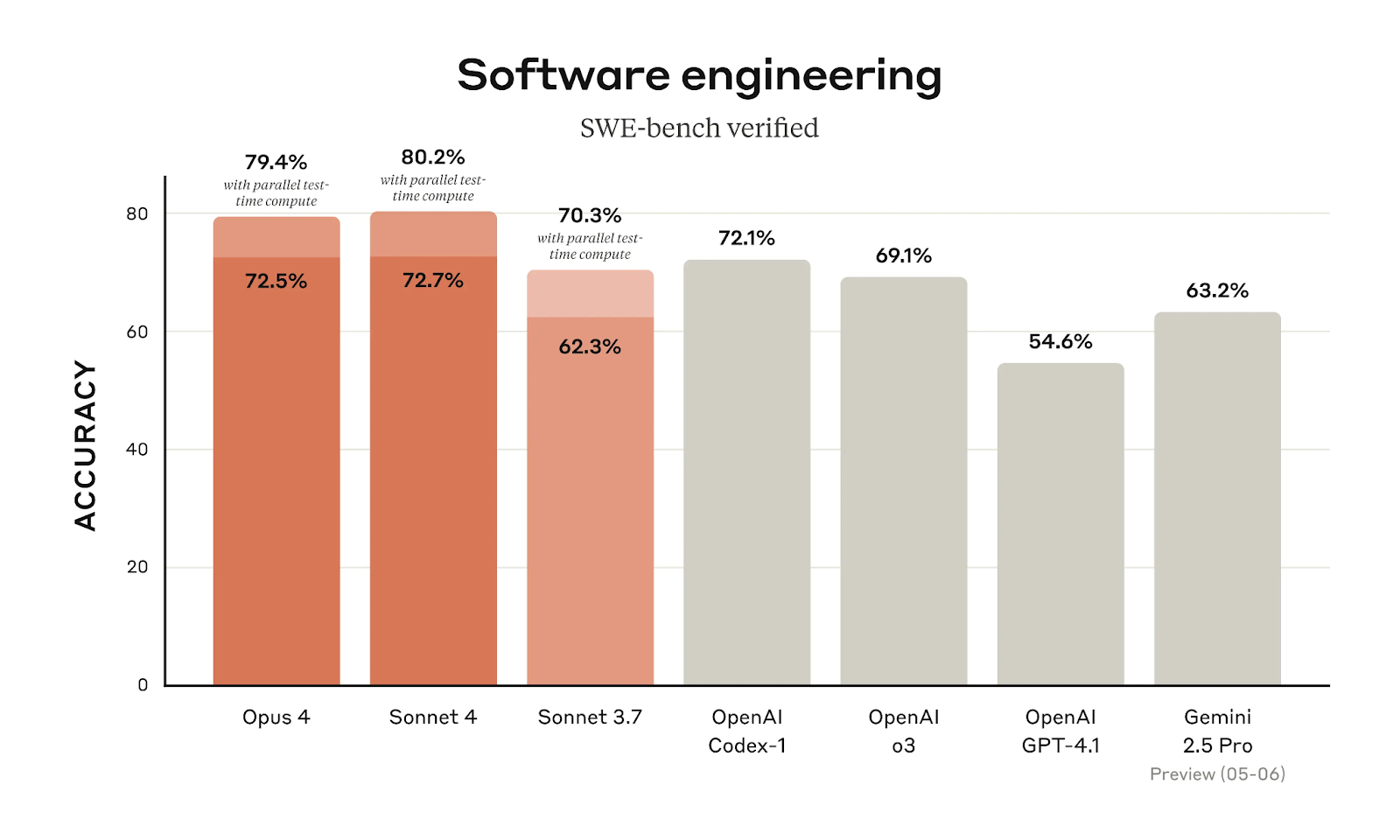
Coding benchmarks. Source: entelligence.ai
Key takeaways from coding tests:
- Claude Sonnet 4 shows a clear advantage over Gemini 2.5 Pro in the SWE-bench test, suggesting its superior performance in solving practical programming problems.
- The ability to parallelize processing significantly improves the performance and throughput of Claude models, enabling complex tasks to be completed faster.
- Claude Sonnet 4 emerges as a strong candidate for a wide range of software engineering tasks, from code generation to refactoring and debugging.
Reasoning Skills and Multitasking: An Equal Fight?
Outside of the code domain, both the Claude 4 and Gemini 2.5 Pro families perform at a high level in tasks that require advanced reasoning and multitasking. In tests such as GPQA Diamond, which assesses the ability to answer academic-level questions that require deep understanding and synthesis of information, top models including Claude Opus 4, Sonnet 4 and Gemini 2.5 Pro achieve very similar high scores.
This demonstrates their ability to deal with complex intellectual problems.
The situation is interesting in the TAU-bench (Tool-Augmented Usage) tests, which measure how effectively models can use external tools (e.g. API, calculators) to solve the given tasks. Claude models demonstrate their strength in specific domains, e.g. retail, which suggests their great potential in building intelligent e-commerce agents or customer service systems.
In turn, in visual reasoning tests, such as MMMU validation (Massive Multi-discipline Multimodal Understanding), which assess the ability to understand and reason based on data from various modalities (text, image), Gemini 2.5 Pro, alongside OpenAI models, maintains a strong position. Its multimodal roots and training on diverse visual data give it an advantage in analyzing images, charts and video scenes.
It is also worth noting Claude Opus 4's impressive performance in the AIME 2025 (American Invitational Mathematics Examination), a prestigious mathematics competition. Success on this test highlights his advanced abilities in logical thinking and solving complex mathematical problems, which are key not only in science but also in advanced programming and data analysis.
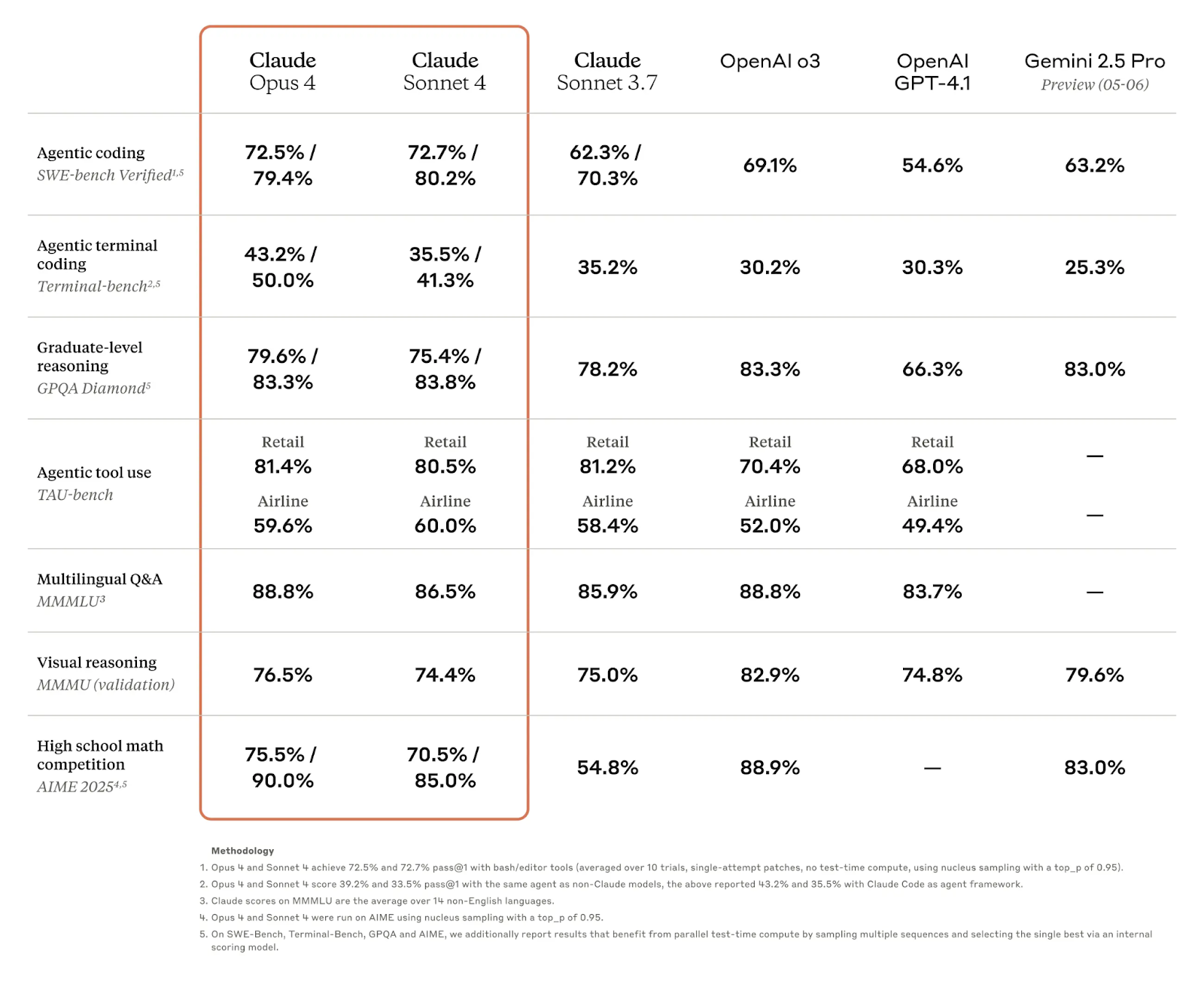
Reasoning and Multitasking Benchmarks. Source: entelligence.ai
Innovations in the Claude 4 Family
Anthropic did not stop at improving existing metrics, introducing a number of innovative features to the Claude 4 series that significantly expand their capabilities:
- Extended Thinking with Tools (Beta – Tool Use/Function Calling): Opus 4 and Sonnet 4 models can now not only call predefined external tools (e.g. calculator API, product database, web search engine), but also intelligently decide When and whose tools to use to most effectively answer the user's query. This is the foundation for building autonomous AI agents capable of independently planning and performing complex tasks, such as organizing travel or managing interactions with customers.
- Parallel Tool Execution: The ability to use multiple tools at the same time is the next step forward. For example, if a task requires gathering information from several different APIs, the model can initiate these operations in parallel rather than sequentially. This significantly reduces response times and allows you to build more responsive and advanced agency applications.
- Better Instruction Tracking and Memory: Claude 4 models are much more accurate in following complex, multi-step commands and have a better ability to retain information from longer interactions. This is especially visible when accessing local files (e.g. via API), which allows for in-depth analysis and use of the content of documents provided by the user for tasks such as summarization, Q&A or code generation based on extensive specifications.
- Less Tendency to Use Shortcuts (Reduced “laziness”): New models are less likely to try to “cheat” the system by giving evasive or incomplete answers to complex queries. Increased “conscientiousness” means that Claude 4 is more likely to put in the effort and deliver a complete, useful result, for example by generating a larger piece of code or more insightful analysis.
- Chain-of-Thought Summaries: For complex queries that require multi-step reasoning or the use of tools, Claude 4 can optionally generate abbreviated summaries of his “line of reasoning.” This feature increases the transparency of the model's operation, allows the user to understand how the answer was formulated, and makes it easier to identify possible errors in the logic.
- Hybrid Architecture: The models offer both quick answers for simpler queries and a “deep thought” mode for more complex problems. This dynamic allocation of computing resources allows you to balance the speed of response with the quality and depth of the generated responses, adapting to the nature of the task at hand.
Claude Code: AI Right in your IDE
An important step is the release of Claude Code, an initiative to deeply integrate the capabilities of Claude models into a developer's daily work environment. New extensions for popular code editors such as VS Code and JetBrains environments, as well as dedicated SDKs (Software Development Kits), open up new possibilities.
IDE integration allows for context-aware help, generating code directly in the project, intelligent refactoring, debugging assistance, and writing unit tests - all without having to leave the editor, significantly speeding up work and minimizing distracting context switching.
The SDK allows developers to build custom tools tailored to the specific needs of a project or organization, e.g. automatic generation of documentation in a company standard or code migration tools. It also improves pair programming (AI Pair Programmer), where Claude Code can act as an intelligent assistant that provides suggestions, identifies potential errors, suggests optimizations and supports learning new technologies.
Gemini 2.5 Pro: Still a Dangerous Competitor
Despite Anthropic's strong offensive, Google's Gemini 2.5 Pro remains a model with significant and versatile capabilities. As benchmarks show, it particularly excels in visual reasoning tasks. Its abilities go beyond simple object recognition to include understanding the context of a scene, interactions between elements, and even analyzing complex charts and graphs. This makes it an invaluable tool in medical applications (e.g. analysis of X-ray images), security systems (video monitoring) or e-commerce (automatic generation of product descriptions based on photos).
Gemini 2.5 Pro also maintains high competitiveness in math tests and general academic reasoning. Thanks to training on huge and diverse data sets, he can deal with a wide range of problems requiring logical thinking, drawing conclusions and synthesizing information.
Its performance in some encoding tests, especially agency and terminal ones, may be lower compared to the latest Claude models, but it is still a solid proposition for many applications, especially where versatility and multimodal capabilities or integration with the extensive Google Cloud ecosystem are key.
Availability and Price List
Claude Opus 4 and Sonnet 4 are available through Anthropic API and cloud platforms such as Amazon Bedrock and Vertex AI (Google Cloud), making them easy to integrate with existing infrastructure.
The table below shows approximate prices per million tokens (word fragments, where on average 1 token is approximately 4 characters in English) for individual models:
| Model | Price per million tokens (in/out or range) | Availability |
|---|---|---|
| Claude Opus 4 | $15 / $75 | API Anthropic, Amazon Bedrock, Vertex AI (Google Cloud) |
| Claude Sonnet 4 | $3 / $15 | API Anthropic, Amazon Bedrock, Vertex AI (Google Cloud) |
| Gemini 2.5 Pro | $10 – $20 (pricing preview) | Google Cloud |
Rates for Claude models are similar to previous generations. In a market context, the Claude Opus 4 sits in the premium segment, comparable to or slightly more expensive than the GPT-4 Turbo, while the Sonnet 4 offers a much more affordable price point, competing with models like the GPT-3.5 Turbo.
The Gemini 2.5 Pro price list in Google Cloud is still in the pricing preview stage. Both ecosystems, Anthropic and Google, offer flexible payment plans that can include pay-as-you-go models, reserved bandwidth discounts for larger customers, and varying levels of technical support, allowing you to tailor costs to the scale and needs of your project.
Practical Application: Generating a Weather Card
To illustrate the practical differences, the original article presents the task of creating an animated weather card. Both models, Gemini 2.5 Pro and Claude Sonnet 4, took on this challenge by generating HTML, CSS, and JavaScript code. However, please remember that this is a single, anecdotal example and results may vary depending on the complexity of the task and the specifics of the prompt.
Gemini 2.5 Pro provided code for a night-themed card with aesthetic animations of the moon, stars and wind, focusing on the visual aspect.

Weather card visualization (Gemini 2.5 Pro). Source: entelligence.ai
Claude Sonnet 4 took a slightly different approach, offering a more interactive tab with dynamic backgrounds and the ability to change the weather data displayed.
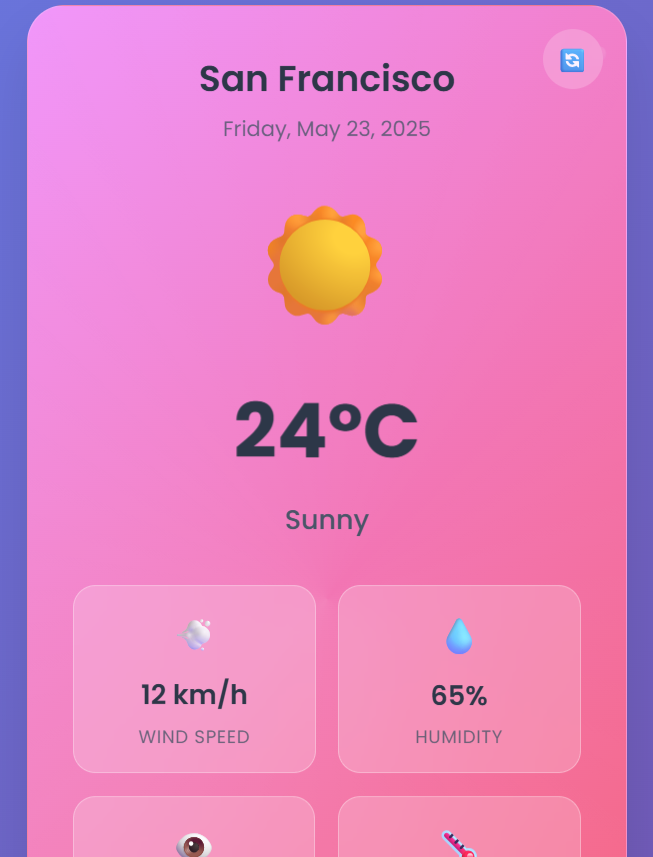
Weather card visualization (Claude Sonnet 4). Source: entelligence.ai
The author's assessment of the original text indicates a preference for the Claude Sonnet 4 solution, due to the richer functions and interactivity of the generated card. This difference in approach may be due to different "strengths" of the models or their training data. Gemini may have prioritized aesthetics, while Claude Sonnet 4, perhaps due to its focus on generating functional code, placed greater emphasis on interactivity and dynamic elements, which is often desired in modern web applications.
Making a Decision: Which Model Is for You?
Choosing the right AI model is a strategic decision and depends on the specifics of the project, priorities and available resources:
- For advanced, multi-step programming tasks, where the highest precision, the ability to perform complex algorithmic reasoning and generate safe, effective code are important, Claude Opus 4 seems to be the favorite. His coding benchmark scores and math skills suggest he's ready to tackle the toughest challenges.
- If you need solid support in everyday coding, rapid prototyping and tasks such as refactoring or writing tests, while maintaining optimal costs, Claude Sonnet 4 offers an excellent compromise between performance and price. Its competitive performance on SWE-bench makes it a very attractive choice.
- For projects that rely heavily on analysis of image, video, sound and other non-text data (multimodal tasks), Gemini 2.5 Pro still remains a very strong candidate thanks to its native capabilities in this domain and proven performance on the MMMU benchmark.
- Creation autonomous tool-controlled AI agents, which are intended to interact with external systems (API, databases), is another domain in which new models Claude 4, with their advanced Tool Use features, ability to use tools in parallel, and better instruction tracking, can shine.
- By limited budget or for large-scale applications where unit cost is critical, Claude Sonnet 4 is an attractive alternative to the more expensive Opus 4, without drastically sacrificing key capabilities, especially in the area of coding.
- For demanding projects a versatile model capable of handling a variety of tasks (not just coding), generating creative content and easy integration with Google Cloud services, Gemini 2.5 Pro remains a very strong and flexible option.
It is worth remembering that Claude 4 is new on the market. While initial data and features are promising, a full assessment of its capabilities will only be possible after more extensive, independent testing and feedback from real-world implementations. Issues such as effective use of the context window, stability in long-running tasks, and nuances in interaction with different types of tools are aspects that require further observation. Benchmarks are a valuable indicator, but hands-on testing on your own specific use cases is absolutely key.
Final Summary
The premiere of the Claude Opus 4 and Sonnet 4 models undoubtedly intensifies competition in the artificial intelligence market, especially in the dynamically developing area of programming and agency applications. Anthropic's innovations, such as augmented tool thinking, parallel tool invocation, and improved comprehension and memory capabilities, open up exciting new prospects for AI developers and creators.
At the same time, Google's Gemini 2.5 Pro is not giving up, remaining a leader in certain niches, especially those related to advanced multimodal processing and visual understanding, as well as offering solid versatility. The final choice of tool should be dictated by an in-depth analysis of your own needs, the specifics of the project, performance requirements for specific tasks and the available budget.
Regardless of individual preferences, one thing is certain: the current dynamics of development of AI models brings huge benefits to the entire technology industry. Developers and enterprises around the world are gaining access to increasingly powerful and intelligent tools. We encourage you to experiment on your own and stay up to date with the development of these fascinating technologies, as the AI landscape changes almost daily.
For more details, including a sample Claude 4 API access code, please refer to original article on the Entelligence blog.