

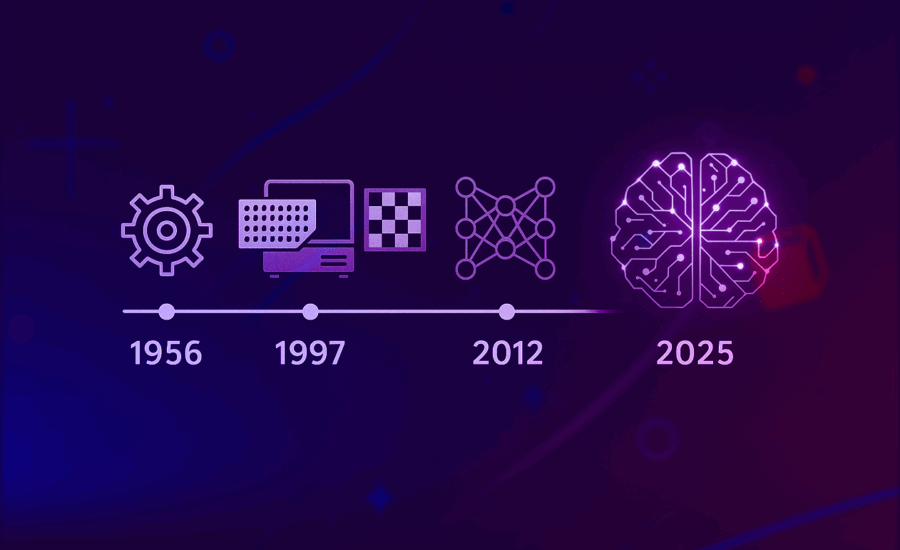
When was AI really born?
The story of a revolution that lasted 70 years.
Artificial intelligence seems to have emerged overnight, revolutionizing our world in just a few years. The truth, however, is much more complex. It is a story of decades of dreams, spectacular successes and painful failures. So when was AI actually born?
What will you find in the article?
- Myths and Dreams: The Ancient Origins of Ideas
- The Birth of a Term: The Dartmouth Workshop (1956)
- First successes and a cold “AI winter”
- The Return of the Machines: Deep Blue and the Age of Expert Systems
- The Deep Learning Revolution (2012-): the breakthrough that changed everything
- Transformer Architecture and the Age of Generative AI (2017-)
- Present and future: AI agents and what's next?
- Summary: AI is a marathon, not a sprint
Recent years have seen an unprecedented boom in the field of artificial intelligence. Language models such as GPT-4, Claude 3 and Grok-4 have become part of our everyday life, and AI agents are starting to automate complex business processes. To fully understand where we're going, we first need to go back in time and see how long and rocky the road has been to get here.
1. Myths and Dreams: The Ancient Origins of Ideas
The very concept of artificial, autonomous entities is as old as civilization. From mythological figures such as Talos, the bronze giant guarding Crete, through the medieval legends of the Golem, to the mechanical automata of the Enlightenment, humanity has always dreamed of creating a thinking machine. However, these were just dreams that lacked a key element - computing power.
2. The Birth of a Term: The Dartmouth Workshop (1956)
The summer of 1956 is considered the official birth date of artificial intelligence as a scientific field. Then, at the University of Dartmouth, a group of visionary scientists, including John McCarthy, Marvin Minsky, Allen Newell and Herbert A. Simon, organized workshops. It was McCarthy who first used the term “artificial intelligence”. Their design proposal was extremely optimistic: they believed that every aspect of learning and intelligence could be described so precisely that a machine could simulate it. They assumed that within one generation it would be possible to create machines with intelligence comparable to humans.
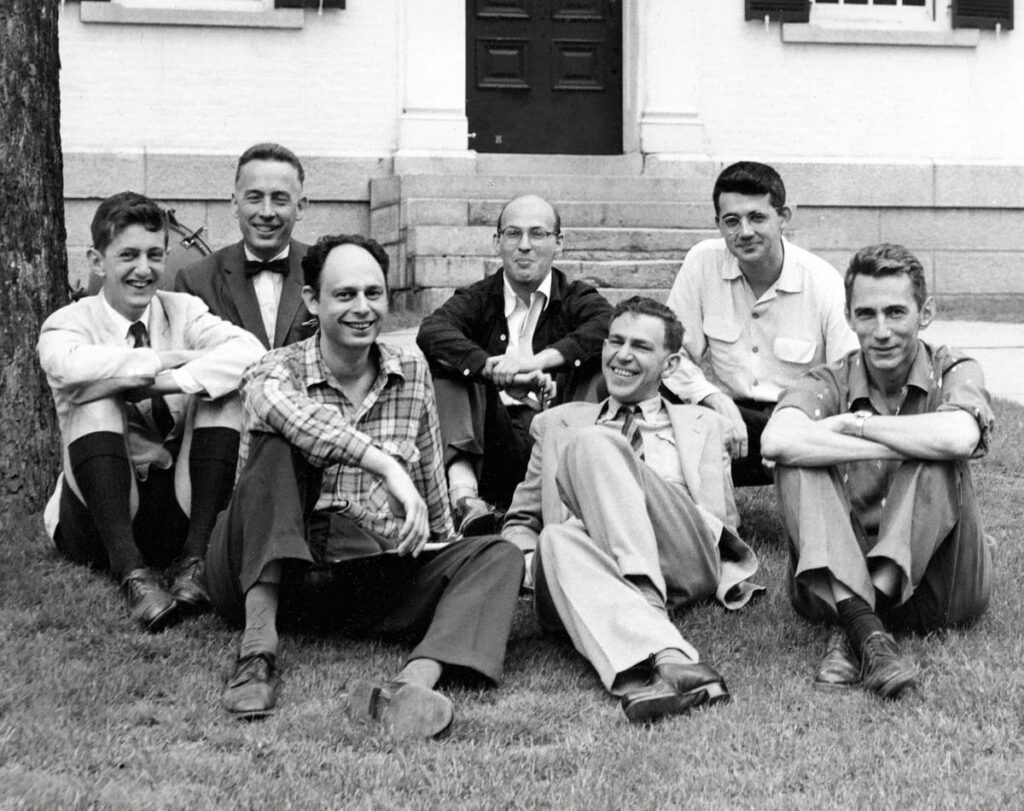
A symbolic photo showing the silhouettes of scientists "Artificial Intelligence, Summer 1956".
3. First successes and the cold “AI winter”
The initial optimism brought the first, simple successes. Programs have been created that can solve algebraic problems or play checkers. One of the most famous programs of that era was ELIZA (1966) - a simple chatbot simulating a conversation with a psychotherapist. However, it quickly turned out that real world problems were much more complicated.
The promises were far ahead of the real possibilities of the technology. When governments and investors realized that the breakthrough would not come as quickly as expected, research funding was drastically cut. The so-called “AI winter” – a period lasting from the mid-1970s to the early 1980s, characterized by stagnation and lack of interest in the field.
4. The Return of the Machines: Deep Blue and the Age of Expert Systems
AI came back into favor in the 1980s with the development of the so-called expert systems. These were programs that stored a huge knowledge base on a specific, narrow topic (e.g. medical diagnostics) and were able to draw conclusions based on it. The culmination of this era was 1997, when the IBM supercomputer, Deep Blue, defeated the reigning world champion, Garry Kasparov, in a chess match. It was a symbolic moment when a machine defeated a human in a domain considered to be the pinnacle of intellectual capabilities.
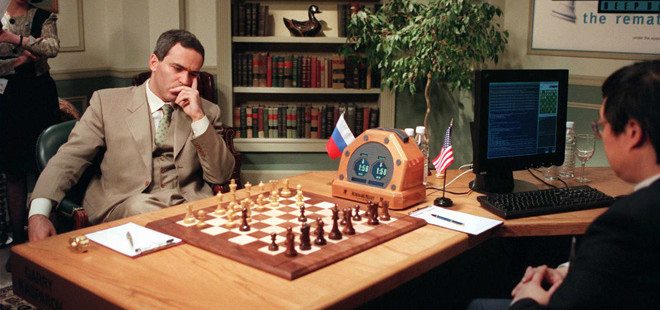
The iconic photo of Garry Kasparov sitting at a chessboard in front of a Deep Blue computer monitor. It is a visual symbol of a breakthrough.
5. Deep Learning Revolution (2012-): The breakthrough that changed everything
The real, exponential development of AI began around 2012. It was then that three key factors came together to make the Deep Learning revolution possible:
- Huge data sets (Big Data): The Internet has become an inexhaustible source of data (texts, images, sounds) necessary for training neural networks.
- Powerful computing power: The development of graphics cards (GPUs), originally intended for gaming, proved crucial. They enabled parallel data processing on a massive scale.
- Breakthroughs in algorithms: In 2012, a neural network called AlexNet outclassed the competition in the ImageNet image recognition competition. This proved that deep neural networks are extremely effective in solving complex perceptual problems.
This was the moment when AI began to “see” and “hear” the world with unprecedented precision.
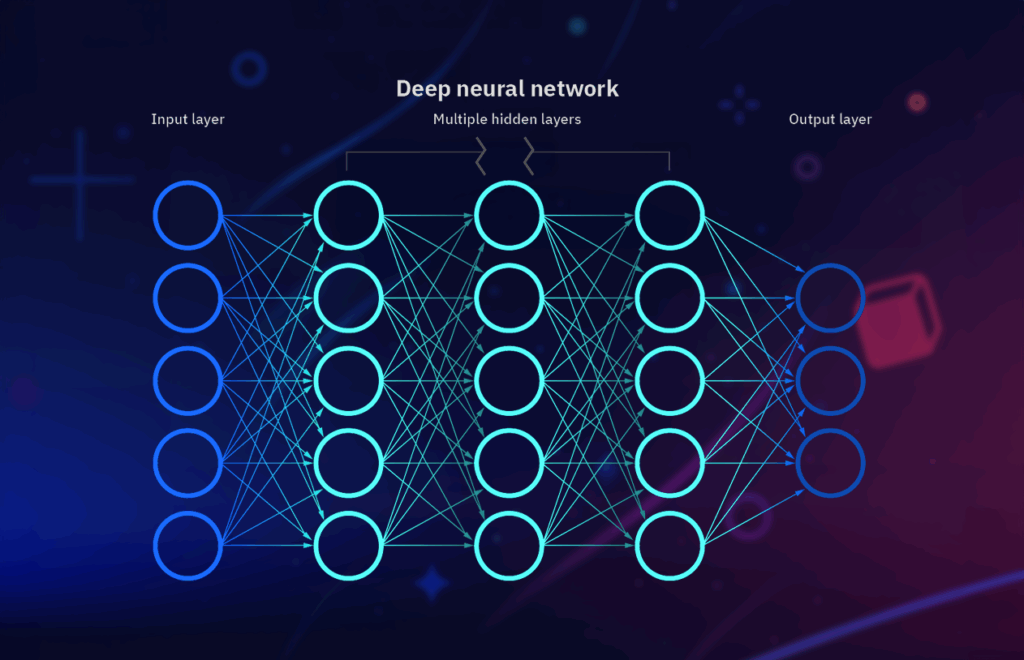
Visualization of a multi-layer neural network (Deep Neural Network).
6. Transformer Architecture and the Generative AI Era (2017-)
Another milestone came in 2017, when researchers from Google published a paper entitled “Attention Is All You Need”. They introduced a new neural network architecture called Transformer. It proved revolutionary in natural language processing because it allowed models to understand the context and relationships between words in long sequences of text. It is on this architecture that all modern language models are built, including the GPT series from OpenAI, which led to the creation of ChatGPT and the global boom in generative AI.
7. Present and Future: AI Agents and What's Next?
Today, in July 2025, we are in the heart of the generative era of AI. Language models not only understand language, but can create it, write code, analyze images, and conduct complex conversations. The next natural step in evolution, which is happening before our eyes, is development AI agents. These are systems that not only process information, but based on it independently plan and perform multi-stage tasks using external tools. This is a transition from a passive assistant to an active, digital employee.
 .
.
8. Summary: AI is a marathon, not a sprint
Answering the question from the beginning: although the term "artificial intelligence" is almost 70 years old and dreams about it date back to ancient times, the technology we interact with today is the result of breakthroughs of the last 10-15 years. Its “sudden” success is actually the culmination of decades of research, periods of doubt, and quiet, fundamental discoveries. The history of AI clearly shows that this is a marathon, not a sprint, and we are witnessing perhaps the most exciting stage of this race.