

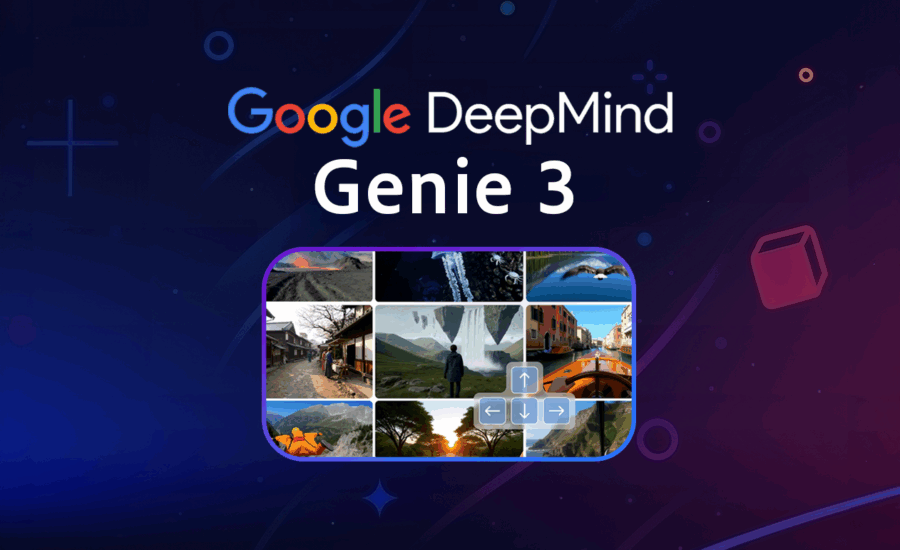
Genie 3 vs. the rest of the world: Why AI interactivity changes everything?
OpenAI Sora and Google Veo 3 revolutionized video generation in their pursuit of cinematic photorealism. However, Google's latest model, the Genie 3, is not in this race. Instead, it creates an entirely new category - interactive worlds on demand. We analyze what this means for the future of AI.
What will you find in the article?
- Two paradigms: Video generation versus world simulation
- Model Comparison: Genie 3 vs. Sora vs. Veo 3
- What is the “World Model” and why is it a breakthrough?
- What does Genie 3 really bring? New opportunities and markets
- Summary: Simulation as the new frontier of AI
In 2025, the AI market has been dominated by the video generation race. Models like Sora from OpenAI or Veo 3 from Google have shown that AI can create photorealistic, coherent and almost cinematic clips from simple text. Just when it seemed that the future was even higher resolution and longer videos, Google DeepMind showed off Genie 3 – a model that, although also generates video, represents a fundamentally different philosophy.
1. Two paradigms: Video generation versus world simulation
To understand the importance of Genie 3, we need to distinguish between two goals that AI can pursue in the context of a moving image:
- Video Generation (Sora/Veo paradigm): The goal is to create passive, non-linear video clip of the highest possible visual quality and consistency. The user provides a prompt and receives a ready-made video to watch. The model learns the physics of the world to generate a believable video.
- World Simulation (Genie 3 paradigm): The goal is to create active, interactive environment, which responds to user actions in real time. The user is not just a viewer, but a participant. The model learns the physics of the world to reliably predict and generate its next state in response to an action.
To put it simply: Sora and Veo are revolutionary film directors. Genie 3 is a revolutionary game and simulator creator.
Your browser does not support the video tag.Sora and Veo 3 create passive videos to watch, while Genie 3 generates active worlds to explore.
2. Model comparison: Genie 3 vs. Sora vs. Veo 3
The table below summarizes the key differences between the leading models, highlighting their different goals and market positioning.
| Characteristic | Google Genie 3 | OpenAI Sora / Google Veo 3 |
|---|---|---|
| Main function | Real-time simulation of an interactive world | Generate high-quality passive video |
| User interaction | Active (navigation, exploration, modification) | Passive (providing a prompt, viewing the result) |
| Technology priority | Low latency, time consistency, responsiveness | Photorealism, cinematic quality, complex physics |
| Output | Continuous video stream (e.g. 24 fps), state of the world | Finished video file (.mp4) |
| Main use | Game prototyping, robot training, education | Film production, advertising, content creation |
| Metaphor | Game and simulation engine | AI film director |
3. What is the “World Model” and why is it a breakthrough?
Genie 3 is a representative of a new class of systems known as “World Models”. Unlike language models (LLM), which learn to predict the next word, a world model learns to predict next state of the world based on its current state and the action taken. This is a fundamental change that allows AI to move from statistical pattern matching to a rudimentary understanding of causality.
The model is trained on millions of hours of internet video, particularly video game footage. Thanks to this, he learns not only what the world looks like, but also what laws (physics, logic of interaction) govern it. When a user in the Genie 3 world presses the "forward" button, the model does not play the finished animation - it predicts and generates in real time, frame by frame, what the world should look like after this action.
4. What does Genie 3 really bring? New opportunities and markets
While Genie 3's visual quality may currently be inferior to Sora's cinematic realism, its interactivity opens up completely new, powerful possibilities:
- Game Development: This is the biggest beneficiary. Genie 3 allows for rapid prototyping. Instead of months of work by graphic designers and programmers, a playable world concept can be created in a few minutes from a description or sketch. It democratizes game development.
- Robotics and autonomous systems: This is Google's strategic goal. Training robots in the real world is expensive and dangerous. Genie 3 provides an infinite number of safe, virtual training grounds, which is crucial to the development of AI capable of operating in the physical world.
- Education and training: The ability to create interactive simulations on demand – from historical reconstructions to complex medical procedures – turns passive learning into an active experience.
- New forms of media: Genie 3 is a preview of interactive films, music videos and works of art in which each viewer becomes a participant, co-creating a unique experience.
Genie 3's interactivity opens the door to a revolution in many industries, from gaming to training advanced robots.
5. Summary: Simulation as the new frontier of AI
The arrival of Genie 3 proves that the AI race is not just on one track. While models like Sora and Veo 3 strive to perfectly mimic our reality in the form of passive video, Genie 3 focuses on **simulating** it in an interactive way. This distinction is crucial. This isn't just "another video generator" - it's a fundamental step towards building machines that learn by doing and interacting, not just by observing. From this perspective, Genie 3 is not a competitor to Sora, but a complementary tool that pushes the entire field of AI on completely new tracks - towards a truly embodied intelligence that understands the world.