

In-depth analysis of Lumo by Proton: A privacy gambit in the AI chatbot market
Proton enters the AI game with its promise of absolute privacy. But is Lumo, their new chatbot, a real alternative to the giants or an expensive experiment? We analyze technology, controversy and strategy.
What will you find in the article?
- Introduction: Proton's AI venture
- Lumo Architecture: A foundation of privacy and sovereignty
- Product Analysis: Features, functionality and limitations
- Market and competitive analysis
- User perception: The dichotomy of opinions
- Strategic outlook and recommendations
1. Introduction: Proton's AI venture definition
Lumo from Proton AG: An AI assistant with a privacy mandate
Lumo, launched in July 2025, is the latest addition to the Proton AG ecosystem. Its introduction is a direct response to the business model known as "surveillance capitalism". Lumo's mission is to deliver the utility of an AI assistant without forcing users to give up control over their data. Proton CEO Andy Yen's vision is clear: artificial intelligence should not become "the most powerful surveillance tool in the world." Lumo is presented as a necessary alternative that serves users rather than exploits them.
Key explanation: Differentiating Lumo from Proton.ai
It is extremely important to clearly distinguish between the two entities. On the one hand, we have Lumo, an AI chatbot from the Swiss company Proton AG, and on the other, the completely unrelated company Proton.ai. Proton.ai is an American company based in Cambridge, specializing in CRM software for B2B distributors. This distinction is key because the presence of Proton.ai poses a risk of brand dilution for Proton AG's Lumo. A user searching for information under the phrase "Proton AI" comes across two different companies, which may lead to confusion.
2. Lumo Architecture: Foundation of privacy and sovereignty
Encryption framework: Multi-layer defense
Lumo's architecture is designed to ensure that privacy is not just a marketing promise, but a technological fact. It is based on several pillars:
- Zero-access encryption: The cornerstone of Lumo safety. All saved chat histories are client-side encrypted, meaning they are impossible to read by anyone, including Proton administrators.
- End-to-end encryption in transit: Lumo uses the Transport Layer Security (TLS) protocol to secure data transmission.
- Asymmetric query encryption: Prompts are asymmetrically encrypted, allowing them to be decrypted only by designated Lumo GPU servers, protecting against man-in-the-middle attacks.
- Verification via open source: Lumo's code is open source, allowing for public auditing and verification of its privacy claims.
Zero-trust data policy: A radical departure from the norm
Lumo's data policy represents a fundamental departure from competitors' practices:
- No logs: Lumo does not store any chat logs on the server side. All session data is immediately deleted.
- No use of data to train AI: Proton explicitly guarantees that user conversations will never be used to train AI models.
- No data sharing: The combination of no logs and zero-access encryption means that Proton physically has no data to share with third parties.
Technological and geopolitical sovereignty
Proton's strategy also includes geopolitical aspects. Lumo is based on open LLM models (Nemo, Mistral Small 3, OpenHands 32B, OLMO 2 32B) and operates in European data centers controlled by Proton. The key move is the decision to invest 100 million Swiss francs and transfer Lumo's infrastructure from Switzerland to the European Union, in response to changes in Swiss law. The move strengthens Lumo's protections under stricter GDPR regulations.
3. Product Analysis: Features, functionality and limitations
Core capabilities and ecosystem integration
Lumo performs fundamental AI tasks such as analyzing and summarizing documents, editing texts, and generating code. Users can upload files for analysis, and Lumo integrates directly with Proton Drive. The system also automatically selects the most appropriate language model (LLM) for a given task.
Distinctive privacy features in practice
- Ghost Mode: A feature similar to Incognito Mode that ensures your conversation disappears forever when you close the window.
- Optional web search: Disabled by default to maximize privacy. Once enabled, Lumo uses privacy-respecting search engines.
Identified performance gaps and constraints
A privacy-first approach comes with trade-offs:
- Lack of multimodal support: Lumo does not currently process or generate images, video, and does not have a voice interface.
- Performance and speed: Early reviews indicate that the Lumo may be slower than the competition.
- Knowledge Cutoff: The knowledge of the model is limited to 2023.
- Response quality: User reviews range from helpful to “useless” for complex tasks.
These limitations are not accidental; are the price for uncompromising privacy. This positions Lumo for a specific user who consciously chooses security over cutting-edge features.
4. Market and competitive analysis
Business model and monetization
Lumo is based on a freemium model, consisting of three tiers: guest (without an account), free (with a Proton account) and paid (Lumo Plus for approximately USD 12.99/month). Lumo Plus is included with the "Visionary" plan, but not with the "Unlimited" plan, which has become a point of contention.
Table 1: Comparison of Lumo plans
| Function | Guest user | Lumo Free | LumoPlus |
|---|---|---|---|
| Monthly cost | Free | Free | ~$12.99 |
| Proton account required | NO | Yes | Yes |
| Chat limits | Limited weekly | Limited | Unlimited |
| Chat history | No record | Basic, encrypted | Extended, encrypted |
| File transfer | Lack | Small files | Large and many files |
| Access to advanced models | NO | NO | Yes |
Competitive Challenge: Lumo vs. Giants
Lumo's main competitive difference from ChatGPT, Gemini, and Claude is not in performance, but in the way it handles data. Lumo's European jurisdiction (GDPR compliance) is a key differentiator.
Table 2: Privacy Policy and Data Handling: Competitive Comparison
| Privacy Meter | Lumo by Proton | ChatGPT (OpenAI) | Gemini (Google) | Claude (Anthropic) |
|---|---|---|---|---|
| Default data logging | No (no server logs) | Yes (unless disabled) | Yes | Yes (storage up to 30 days) |
| Using data for training | Never | Yes (optional) | Yes (can use data) | Not by default |
| E2E encryption of chats | Yes (zero-access) | NO | NO | NO |
| Legal jurisdiction | EU (GDPR) | USA | USA | USA |
Proton assumes that a growing segment of the market (e.g. lawyers, doctors) will value data confidentiality more than having the absolute most powerful model.
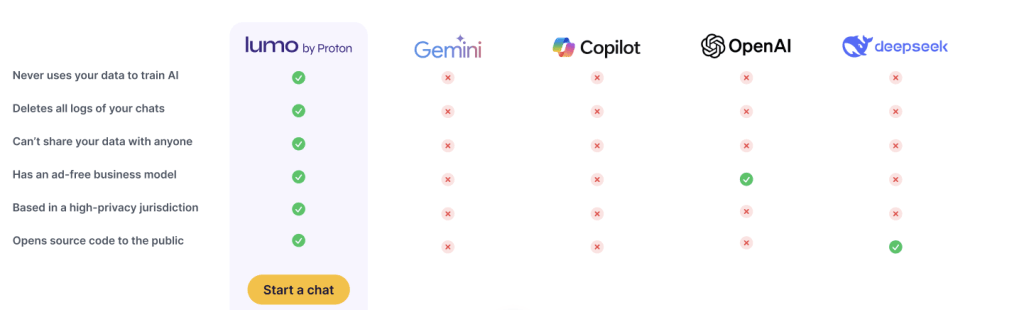
Graphical comparison of Proton Lumo vs the rest of the main players in the AI chat market.
5. User perception: The dichotomy of opinions
Reaction to Lumo has been polarized. On the one hand, privacy advocates welcomed the secure alternative. On the other hand, power users express disappointment with the performance. The loudest group, however, are Proton's current paying customers, who criticize the company for:
- Resource diversification: Introducing new products while basic services (Drive, Pass) are still lacking.
- Controversy surrounding the "Unlimited" plan: Excluding Lumo Plus from this plan is seen as a move that devalues existing subscriptions and is a break of promise.
- "Scope Creep" (scope expansion): Concern that Proton is trying to do too many things at once without refining its core offerings.
The problem is not product privacy, but the company's strategy, which undermines trust, its most valuable asset.
6. Strategic perspectives and recommendations
Lumo Challenge: Balancing privacy and performance
The central challenge for Lumo is the question: Can it remain competitive by cutting itself off from the most valuable source of data for improving models – real interactions with users? Success will depend on advances in the field of open language models.
Future trajectory and integration into the ecosystem
The logical next steps in Lumo's development include deeper integration with other services such as Mail, Calendar, and Docs. However, there is currently no official public roadmap for Lumo.
Recommendations for stakeholders
- For potential users: Lumo is highly recommended for use cases where confidentiality is absolutely non-negotiable (law, medicine). However, users must be willing to compromise on performance.
- For Proton AG: An immediate response to negative community feedback regarding the "Unlimited" plan is necessary. The company should increase transparency in resource allocation and focus marketing on its ideal target group - professionals in regulated industries, presenting restrictions as a conscious design choice for safety.