

ChatGPT Agent: Analyzing OpenAI's Breakthrough Step in the Age of Autonomous AI
Abstract: This report presents an in-depth analysis of ChatGPT Agent, a new OpenAI product that represents a pivotal moment in the evolution of artificial intelligence. Moving from a conversational model to an autonomous task executor, ChatGPT Agent is not just an incremental improvement, but a strategic step towards the commercialization of general agent systems. The analysis includes deconstructing its unified architecture, assessing opportunities in a market context, and exploring its deep strategic, ethical, and economic implications. The report argues that ChatGPT Agent sets a new standard for human-computer interaction while introducing complex security and governance challenges that business and technology leaders must be prepared for.
Section 1: Deconstructing the ChatGPT Agent – Technical and Functional Dive
OpenAI's introduction of the ChatGPT Agent is not just an update to an existing product, but a fundamental change in its identity. To fully understand the importance of this step, it is necessary to disassemble the new system into its prime factors - from its architecture, through the set of tools, to the spectrum of possibilities and the model of interaction with the user. This deconstruction reveals how OpenAI transformed its flagship chatbot from an advanced “thinker” to a competent digital “doer.”
Unified agent system: Evolution from "thinker" to "doer"
The core of the new functionality is unified agent system, which is the culmination and integration of two previous, separate OpenAI research projects: “Operator” and “Deep Research”. “Operator” was designed as a tool for interacting with graphical interfaces of websites, able to imitate human actions such as clicking, scrolling and typing text. In turn, “Deep Research” excelled in the in-depth synthesis and analysis of information from many sources, generating comprehensive, structured reports at the analytical level.
Combining these two specialized capabilities in one product is a strategic breakthrough. The ChatGPT agent combines these two personas, creating a system that can do both reason as well as act in one seamless process. This is a fundamental shift from a model that *answers* questions to an agent that independently *performs* multi-step tasks from start to finish.
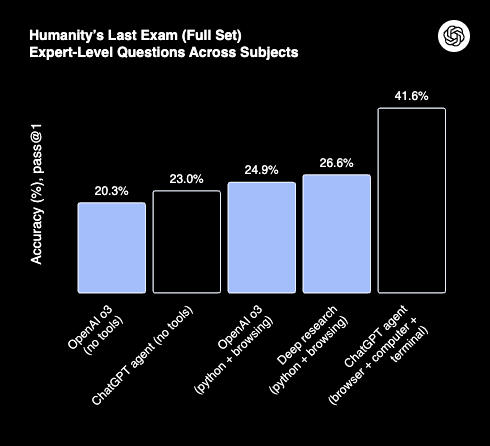
Effectiveness (pass@1) in difficult expert questions. ChatGPT agent with full toolkit (41.6%) significantly outperforms other models and configurations.
Agent Toolkit: A virtual computer at your fingertips
To enable complex tasks to be performed, the ChatGPT Agent runs in its own isolated environment “virtual computer”. This sandbox environment allows him to maintain context and switch seamlessly between a variety of tools without losing progress toward the overarching goal. Its arsenal of tools is comprehensive and designed with flexibility in mind:
- Visual Browser: A key tool for interacting with the modern, graphical web.
- Text-Based Browser: Optimized for speed and performance.
- Terminal: It gives the agent the ability to run code, manipulate files, and perform system operations.
- Direct API access and Connectors: They enable integration with third-party applications.
The charts below show how effective Agent is at web browsing tasks compared to other models.
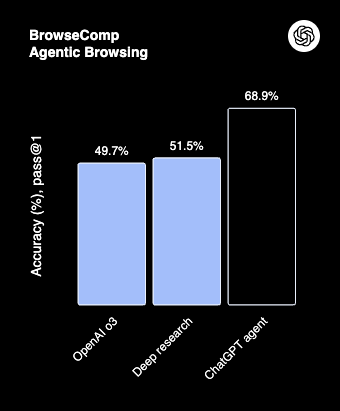
Performance (pass@1) on tasks requiring browsing. The ChatGPT agent (68.9%) performs significantly better than previous models.
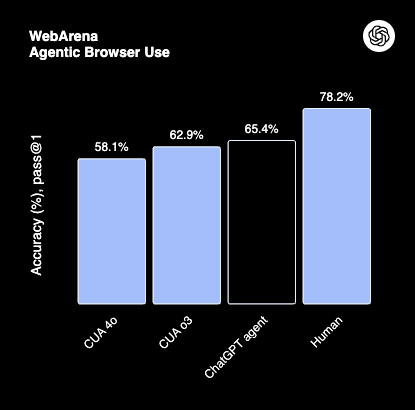
Performance in browsing tasks (WebArena). The ChatGPT agent (65.4%) approaches the human level (78.2%).
Possibilities and applications: Automation of complex intellectual work
The ChatGPT agent is designed to handle complex, multi-step tasks. Its potential applications illustrate the leap from content generation to performing complete business and personal processes. Examples include data analysis, spreadsheet work, and investment banking tasks.
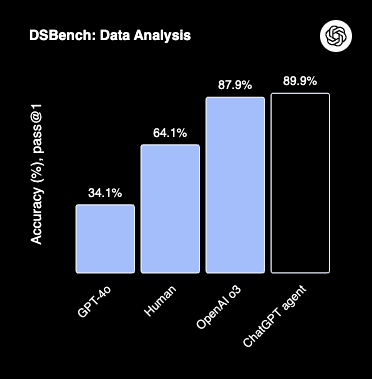
Efficiency (pass@1) in data analysis. ChatGPT agent (89.9%) and OpenAI o3 model (87.9%) significantly outperform human expert (64.1%).
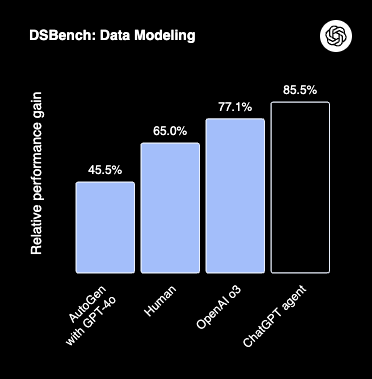
Relative performance gains in data modeling. The ChatGPT agent (85.5%) again shows a significant advantage over the human (65.0%).
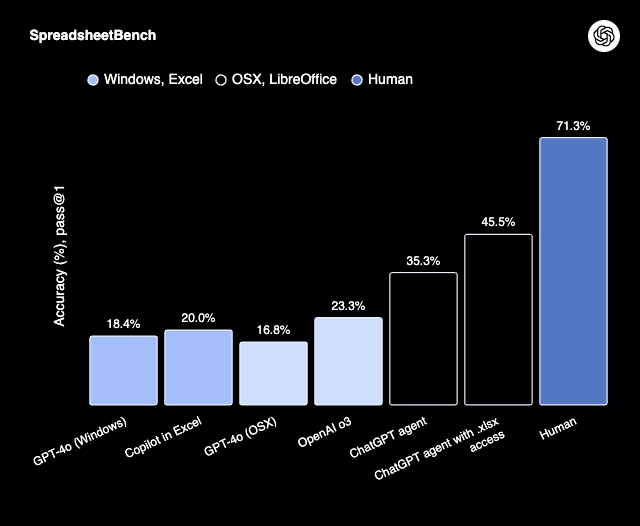
Effectiveness on spreadsheets. Agent with direct access to the .xlsx file (45.5%) is more than twice as good as Copilot in Excel (20.0%).
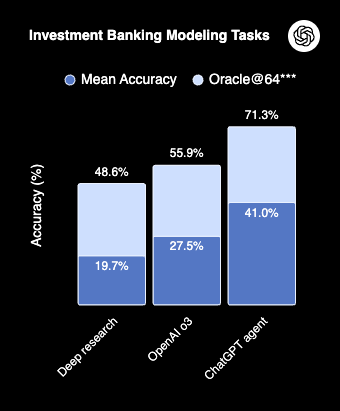
Effectiveness in modeling investment banking tasks. The ChatGPT agent (71.3%) shows significant improvement over previous models.
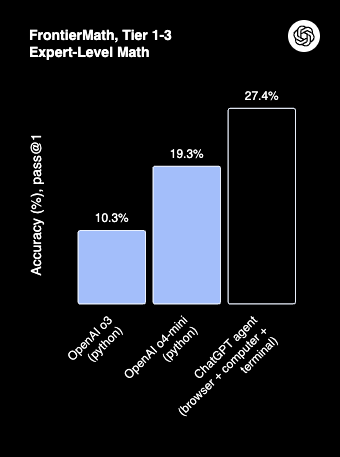
Efficiency (pass@1) in difficult math tasks. The ChatGPT agent (27.4%) is almost three times better than the OpenAI o3 model (10.3%).
User Interface and Accessibility: A Collaborative and Controlled Partnership
The interaction with the Agent was designed based on a fundamental principle “human-in-the-loop”, which ensures that the user retains full control over the process. This control architecture is a key element of OpenAI's risk management strategy.
Section 2: Agent AI paradigm – placing the ChatGPT Agent in context
The introduction of the ChatGPT Agent is not an isolated event, but part of a broader technological trend - its birth agent artificial intelligence (Agentic AI). Agent systems represent the next stage in the evolution of AI, moving from models that passively process information to systems that actively and autonomously operate in the digital world.
Section 3: Competitive arena – OpenAI's position in the market
The launch of ChatGPT Agent doesn't happen in a vacuum. It is a move as part of an intense technology race involving both tech giants, a vibrant open-source community, and agile startups creating specialized solutions.
Comparison table: Analysis of leading AI agent platforms
To visualize the strategic positioning of the main players, the table below summarizes the key features of their approaches to AI agents.
| Characteristic | ChatGPT Agent (OpenAI) | Gemini Agents (Google) | Agents Claude (Anthropic) | Open-Source frameworks (e.g. LangChain/CrewAI) |
|---|---|---|---|---|
| Main philosophy | A universal, single-agent "performer" for the mass professional user. | A set of specialized tools for developers and specific tasks. | Structured, secure “workflows” with an emphasis on reliability. | Modular "building blocks" for developers to build custom systems. |
| Architecture | A unified single-agent system with dynamic tool selection. | Diverse: from CLI agents to specialized models. | A clear distinction between predefined “workflows” and dynamic “agents”. | Compositional, based on chains, roles or graphs. |
| Control mechanisms | Strong emphasis on “human-in-the-loop”, constant supervision, requests for consent. | Product dependent; in Code Assist control in the IDE. | Emphasis on simplicity and clarity of design, defined checkpoints. | Full control in the hands of the developer. |
| Target user | Professionals, "knowledge workers", users of Pro/Team plans. | Developers, security specialists. | Enterprises and developers building reliable applications. | Developers, researchers, technology companies. |
Section 4: Navigating the New Frontier – Risks, Ethics and Strategic Imperatives
The introduction of powerful, autonomous AI agents on a massive scale opens a Pandora's box of complex challenges. The ability of these systems to operate independently raises fundamental questions about safety, ethics and the future of work.
The future of work: Transformation at the task level
The impact of AI agents on the labor market is primarily due to automation tasks, not entire positions. The chart below illustrates how the ChatGPT Agent performs on economically important tasks compared to humans.
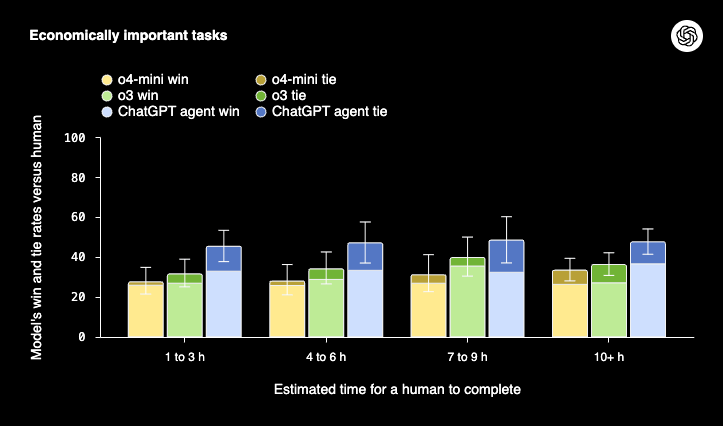
Comparison of performance of AI Agents and humans on tasks of different durations. The ChatGPT agent shows a high number of wins and draws, especially in tasks lasting 1-3 hours.
This leads to a phenomenon that can be called “skills inversion”. An employee's value will become less and less about their ability to perform data analysis themselves and more and more about skills in orchestrating, supervising and asking the right questions to a team of AI agents.
Conclusions and strategic perspectives
The ChatGPT agent is not just another tool in your digital toolbox. Its launch symbolizes the beginning of a new era in computing, where interaction with machines moves from direct commands to delegating goals using natural language.
Strategic implications for business:
- The need for immediate experimentation: Companies need to start experimenting with AI agents to understand how they can redefine existing workflows.
- Investment in the development of “meta-skills”: Training programs must focus on competencies that complement AI, such as critical thinking and creativity.
- Priority for corporate governance, security and ethics: The implementation of agents must go hand in hand with the development of a solid governance framework.
Long-term perspective:
The ChatGPT agent is a harbinger of a future where every professional will have a team of personalized, autonomous AI agents at their disposal. The companies that first master the art of managing this new workforce will gain a decisive advantage in the AI-driven economy.
Source: OpenAI